SHA256 Hash Explorer
Interactive SHA256
Enter your text to generate its SHA256 hash.
SHA256
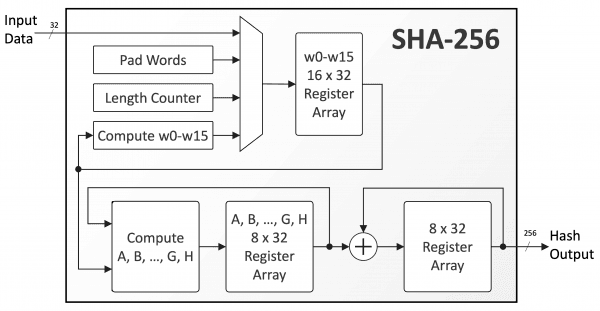
SHA256 Process Visualization
About SHA256
Description
SHA256 (Secure Hash Algorithm 256-bit) is a cryptographic hash function used for secure data hashing. It generates a fixed-size 256-bit (64-character) hash value from any input, ensuring data integrity and security.
How it Works
- Padding: The input message is padded to ensure its length is a multiple of 512 bits.
- Parsing: The padded message is parsed into 512-bit blocks.
- Initialization: Eight 32-bit words are initialized with the first 32 bits of the fractional parts of the square roots of the first 8 primes.
- Compression: Each 512-bit block undergoes 64 rounds of compression, involving bitwise operations and modular addition.
- Final Hash: The result of the compression function is combined to produce the final 256-bit hash value.
Detailed Process
The SHA256 algorithm follows these steps in detail:
- Preprocessing:
- Pad the message so its length is a multiple of 512 bits.
- Parse the padded message into 512-bit message blocks.
- Initialize hash values (H) with the first 32 bits of the fractional parts of the square roots of the first 8 primes.
- Initialize round constants (K) with the first 32 bits of the fractional parts of the cube roots of the first 64 primes.
- For each message block:
- Prepare the message schedule (W) by extending the 16 32-bit words into 64 32-bit words.
- Initialize working variables (a, b, c, d, e, f, g, h) with the current hash values.
- Perform 64 rounds of compression, updating the working variables.
- Compute the intermediate hash value by adding the working variables to the current hash values.
- Produce the final hash value as the concatenation of the final hash values (H).
Mathematical Operations
SHA256 uses the following operations:
- Bitwise operations: AND, OR, XOR, NOT
- Modular addition (addition modulo 2^32)
- Bitwise rotation (circular shift)
- Bitwise shift
Strengths
- Collision resistance: Different inputs produce unique hashes.
- Irreversible: Cannot determine the input from the hash.
- Fast and efficient hashing process.
- Avalanche effect: Small changes in input result in significantly different hashes.
Weaknesses
- Vulnerable to brute-force attacks without additional security measures (e.g., salting).
- Not suitable for encryption or decryption (used only for verification).
- Potential vulnerability to length extension attacks (mitigated with proper implementation).
Applications
- Data integrity verification (e.g., file checksums).
- Password hashing for secure storage (with additional measures like salting).
- Blockchain technology for transaction security.
- Digital signatures and certificate signing.
- Secure communication protocols (e.g., TLS/SSL).
Security Considerations
While SHA256 is highly secure, it should be used with additional measures like salting and key stretching (e.g., PBKDF2, bcrypt) to protect against brute-force and dictionary attacks. For password hashing, specialized algorithms like Argon2 or bcrypt are often preferred due to their built-in protections against various types of attacks.
Future of SHA256
As of 2023, SHA256 remains secure and widely used. However, with the potential advent of quantum computing, research is ongoing into post-quantum cryptographic hash functions that would resist attacks from quantum computers. It's important to stay informed about the latest developments in cryptography and be prepared to transition to newer, more secure algorithms as they become necessary.
Diagram of SHA-256 Algorithm